CNC Workholding: My Go-To Methods for Securing Material
Workholding is one of the ultimate givens of CNC work: you absolutely must have a secure way to keep your material stationary while machining it. There are as many types and approaches to this as there are fish in the sea, and what works beautifully for one technique or material might completely fail for another.
In this post, I’ll walk through several designs and techniques I’ve personally found useful in my shop. For context, my daily-driver setup relies on a replaceable 3/4″ MDF spoilboard, and I often nail or screw my workpieces directly into it.
1. Brass Screws
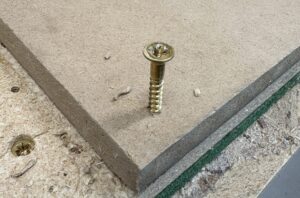
Of course, you always want to avoid contact between your CNC bits and anything made of steel. Brass screws are a simple, inexpensive option for securing your work directly to the spoilboard without worrying about ruining an expensive bit. You can easily find these at your local hardware store.
-
Benefits:
-
Bit Safety: Hardened steel CNC bits will cut through brass like butter if there’s a misplaced toolpath.
-
Cost & Availability: Inexpensive and readily available at any local hardware store.
-
Holding Power: They offer a highly secure, heavy-duty hold down into the MDF.
-
-
Drawbacks:
-
Material Damage: You have to drill holes through your material. If you’re engraving or cutting a piece where the outer edges are already finished, this method isn’t for you.
-
Setup Time: Requires pre-drilling and manually driving screws for every piece.
-
2. Simple Bar Clamp
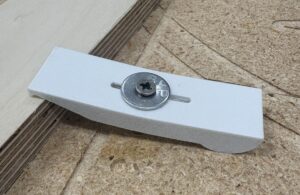
This is my absolute go-to for sheet goods. It’s just a 3D-printed lever held to the spoilboard by a single screw. It features a thickened end that acts as a fulcrum and a ridged lip for gripping the top edge of your material. Download STL file here for 3D printing
-
Benefits:
-
Safety Zone: The securing screw is located far away from any active cutting zones.
-
Low Profile & Forgiving: Even if your toolpath accidentally nicks the clamp, the 3D-printed plastic is no problem for the bit—it will just slice right through it.
-
Easy to Make: Inexpensive to 3D print and customize to whatever height you need.
-
-
Drawbacks:
-
Edge Obstruction: Because it clamps onto the top face/edge, it can get in the way if you need to profile or clean up the very outer perimeter of your workpiece.
-
Manual Adjustment: You still have to tighten and loosen a screw every time you swap stock.
-
3. Vise Grip Clamp
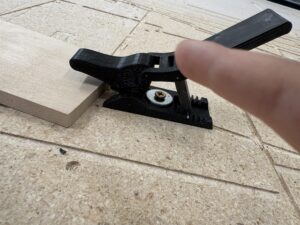

This is a slightly more complex 3D-printed design based on the mechanical concept of Vise-Grip pliers. The idea here is that the over-center lever “locks” the holding foot down onto the material. The clamp parts are held together by metal pins like these (Available on Amazon).
-
Benefits:
-
Speed: Incredibly fast to engage and disengage, which is perfect for repetitive production jobs.
-
No Tools Needed: Once it’s screwed to the spoilboard, you just flip the lever with your hand—no screwdrivers or wrenches required between swaps.
-
-
Drawbacks:
-
Complex Print: More moving parts mean it takes longer to 3D print and assemble, and it has a higher chance of breaking under high pressure.
-
Footprint: Takes up a decent amount of physical space on your CNC bed.
- Strength: (or lack-of) This is made of plastic and is likely to break if over-torqued.
-
Download the Vice Grip Clamp stl file for 3D printing – I recommend printing with 100% infill for extra strength!
4. Spiral Clamp
An experimental take on the 3D printed clamp. This one uses a spiral “ramp” to vary the amount of force that pushes down on the material. Like the Vice Grip Clamp it uses metal pins like these (Available on Amazon) Though it only needs one instead of four per clamp. Same pros and cons as the vice grip clamp except maybe better footprint.
Download the spiral clamp stl file for 3D printing
5. Vacuum Table
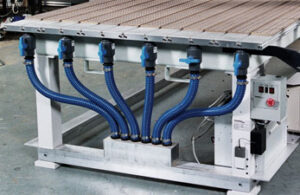
from https://www.cnccookbook.com/router-vacuum-table-cnc-diy/
While I lean toward mechanical holding, sometimes you have material you just can’t hold using conventional means. For example, I have a 1/16″ plywood veneer material that I use for lamps. It’s so thin that nothing will get a very good grip on it so a vacuum table has been the best way I’ve found to hold it so-far. I have not tried double sided tape but I hear that’s a thing. Many CNC creators use a full-table vacuum system integrated directly into their machine. That system requires specialized PVC plumbing, a high powered vacuum pump and and a full-sheet plenum under a special low density particle board (LDF) spoilboard. This is overly expensive IMHO and I prefer a small portable vacuum plenum that I can use with a Shop-Vac type vacuum cleaner.
Enter the small portable vacuum plenum
I have a 24″x24″ model that I pull out whenever I need it and attach my vacuum hose to the inlet at one end. You can find a lot of great community designs for this approach on thingiverse too. If you want to try making your own portable vacuum setup, you can download the 24×24 vacuum table design as DXF. Modify the inlet hole to fit your vacuum (1.75 or 2″ hose are typical) or download this adapter STL file and 3D print it.
-
Benefits:
-
No Surface Marks: Leaves absolutely zero holes, dents, or marks on your material. Perfect for pre-finished wood or plastics.
-
Unobstructed Cutting: The entire top and all four edges of the material are completely open for machining.
-
Lightning Fast: Swapping a piece of material takes seconds—just flip the vacuum switch.
-
-
Drawbacks:
-
Cost & Complexity: Requires an extra vacuum cleaner running and a building a portable plenum.
-
Noise: Vacuum cleaners can add a significant amount of continuous noise to the shop.
-
Small Parts Risk: Small pieces can lose suction and shift mid-cut if they don’t have enough surface area. (Fix: mask over the remaining plenum area with flexible plastic or thin plywood.)
-
6. Composite Nails
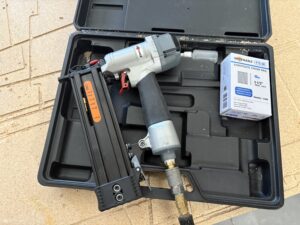
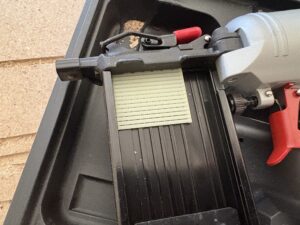
Composite nails are made of fiberglass and a specialized resin that closely mirrors the density of wood. They are shot using a pneumatic nail gun straight into the material and spoilboard.
-
Benefits:
-
Extreme Speed: You can secure a large sheet of material in literally two seconds with a few quick fires of the nail gun.
-
Absolute Bit Safety: The composite material is as soft as wood. If your router bit hits a nail, it cuts right through it without breaking, chipping, or missing a beat.
-
Easy Material Release: When the job is done, you can just pry the piece up; the nails shear off easily.
-
-
Drawbacks:
-
Material Damage: Like brass screws, they leave tiny pinholes in your material, meaning they are best for profiling parts out of a larger sheet rather than engraving finished pieces.
-
Equipment Cost: Requires an initial investment in a dedicated pneumatic composite nail gun and a shop compressor.
-
Material Restrictions: They are stiff enough to shoot straight into plywood or MDF, but they can struggle or buckle when driven into incredibly dense hardwoods like oak or maple.
-
Note on Tooling: The best composite nailer I’ve found is the Spotnails CB1538C 15-Gauge Composite Finish Nailer. I chose it because it’s the only nailer I found that reliably shoots up to 1-1/2″ composite nails. Standard 16-gauge options max out at 1″, which isn’t enough “meat” to hold down a 3/4″ sheet. I don’t have an affiliate relationship with the team at Nail Gun Depot—it was just incredibly hard to find, so I wanted to share the source!
6. T-Track Spoilboard

from https://forum.onefinitycnc.com/
from https://forum.onefinitycnc.com/
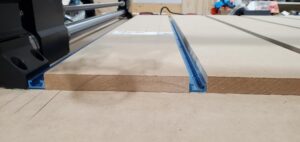
Here is another method that I don’t personally use, but it is wildly popular in the CNC community. A T-track system uses aluminum tracks recessed into the spoilboard, allowing you to slide metal T-nuts and clamps wherever you need them.
-
Benefits:
-
No Spoilboard Damage: You don’t have to constantly screw or nail into your MDF, which extends the life of the board underneath.
-
Versatility: You can quickly reposition clamps to accommodate wildly different shapes and sizes of material.
-
Cleanliness: Keeps the bed organized and allows you to use heavy-duty commercial metal or plastic clamps.
-
-
Drawbacks:
-
High Upfront Setup: Takes a lot of time, precise routing, and aluminum hardware to build out the bed initially.
-
Metal Crash Hazard: If your toolpath has a mistake and crashes into the aluminum T-track or a heavy metal hold-down clamp, it will instantly destroy your router bit and potentially damage your CNC spindle.
-
More Expensive Maintenance: When the MDF sections between the tracks eventually get chewed up, replacing them is a much more tedious task than just slapping down a fresh, solid sheet of cheap 3/4″ MDF.
-
Video: How to make a T Track Spoilboard If you’re interested in making one yourself (I did not make this video).
