Students often mistake Artificial Intelligence for a “black box” design generator—a tool where you input a prompt and receive a rendered image of a building. However, for the contemporary architect, the true power of AI lies not in generating the image, but in facilitating the logic. As we move deeper into the decade, the most significant opportunity for your practice is the use of agentic AI to lower the barrier to entry for complex parametric scripting and performance-driven analysis.
Demystifying the Script: From Syntax to Intent
Parametric design has traditionally been gated by the “syntax wall.” Many brilliant architectural intents are lost because the designer lacks the specific Python or C# expertise to translate a concept into a robust Grasshopper definition. Agentic AI serves as a translator. Instead of getting bogged down in debugging a loop or managing data trees, tools like Raven.AI allow you to describe geometric relationships in natural language, which the AI then translates into working computational logic.
Real-World Case Studies: AI as a Parametric Accelerator
To understand how this moves beyond theory, let’s look at how leading firms use AI-facilitated systems to solve high-complexity problems:
The Airbus Bionic Partition (The Living/Autodesk): 
In this project, designers used “biological algorithms” (inspired by slime mold growth) to optimize a structural plane partition. The AI didn’t “design” the partition; it facilitated a parametric exploration of tens of thousands of iterations to find the lightest, strongest configuration that met strict aerospace safety standards. Explore the Bionic Partition case study.
Semiramis (ETH Zurich / Gramazio Kohler Research): 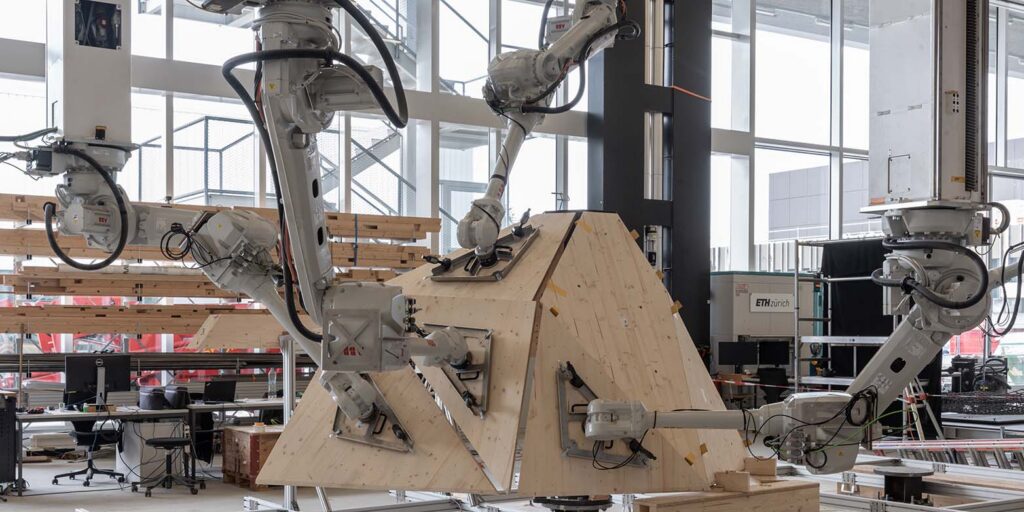
ZHA CODE (Zaha Hadid Architects)
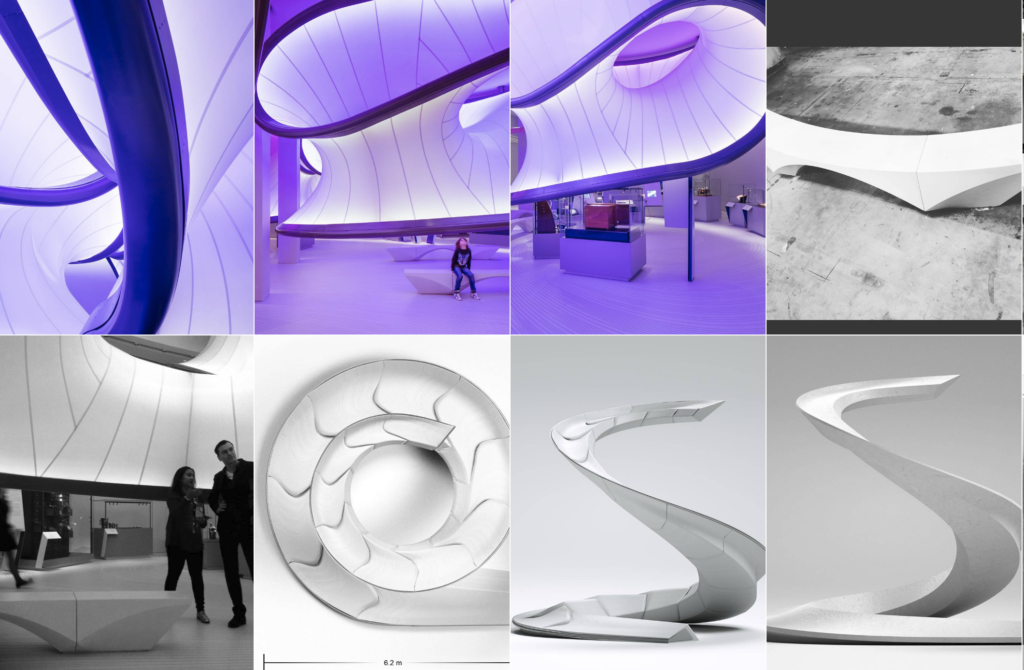
The research arm of ZHA uses custom computational frameworks—like their Geodesic Heat Slicer—to facilitate the robotic 3D printing of complex geometries. By using AI to optimize slicing and toolpath generation, they bridge the gap between abstract NURBS surfaces and the physical limitations of large-scale fabrication. See ZHA CODE’s Integrated Design Research.
Autodesk Toronto Office
One of the most famous examples of “Generative Design” at a workspace scale. Designers set parameters for daylighting, “buzz” (inter-office interaction), and productivity. The AI facilitated the scripting needed to test thousands of floorplan variations, presenting the human designers with the most high-performing options to curate. Read the Autodesk Toronto case study.
From Drafting to Curation
When the technical friction of scripting is removed, your role shifts. You are no longer just a draftsman of lines, but a curator of constraints and variables.
The Professor’s Note: The goal is not to let the AI “think” for you, but to use it to manage the complexity that human cognition struggles to hold all at once.
By using AI to facilitate scripting, you gain the freedom to explore a much wider design space. You can test more variations, integrate more complex material data, and ensure that your designs are grounded in measurable performance.
Conclusion: Mastering the Machine
As students, your objective should be to master the logic of parameters. Understand how a change in one variable affects the whole. Use AI as the power tool that handles the heavy lifting of code and computation, allowing you to remain the primary author of the architectural vision. The future of architecture isn’t about AI-generated buildings; it’s about human-led designs that are smarter, more efficient, and more complex because they were built on a foundation of AI-facilitated parametric logic.
How do you see these automated feedback loops changing the way you approach your studio site analysis?
